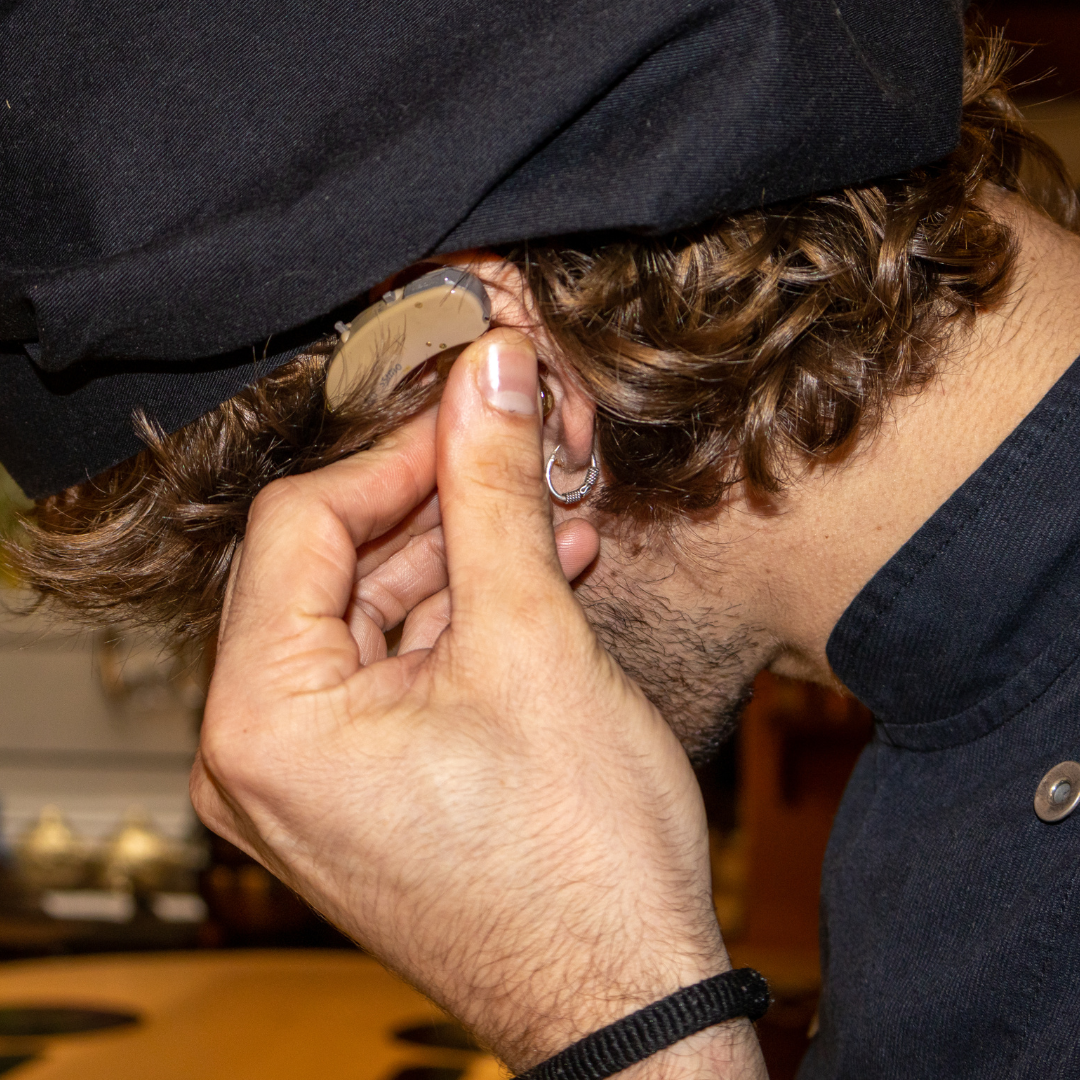
Restaurant conversations can be difficult to follow when environmental noise competes with your focus and hearing. Our clinical team can evaluate hearing across quiet settings and background-noise environments to pinpoint specific auditory challenges. As soon as we identify the physiological cause of your difficult hearing, we deliver personalized rehabilitation options.
Why Can I Hear Normally but Struggle to Listen in a Restaurant?
In quiet conditions, an optimal signal-to-noise ratio ensures that the desired speaker sounds markedly clearer than surrounding sound. Restaurants create the opposite situation. Overlapping chatter, piped music, kitchen clatter, and hard-surface reverberation mask speech, forcing the brain to expend immense cognitive effort to track conversation.
This problem can occur with high-frequency hearing loss, auditory-processing difficulty, or age- and noise-related changes. Visual limitations from low lighting, cognitive fatigue, and sitting farther away from conversational partners amplify speech degradation. Certain patients demonstrate normal sensitivity on routine audiograms while struggling significantly during advanced speech-in-noise testing. Difficulty in restaurants deserves evaluation even when everyday hearing seems normal.
Diagnosing High-Frequency Hearing Loss and Clarity Issues
We begin with a history of the situations that cause trouble, along with questions about noise exposure, tinnitus, medications, family history, and changes in either ear.
Through pure-tone audiometry, we determine your faintest auditory perception across low to high pitches utilizing both air and bone conduction testing. High-frequency loss often creates an audiogram pattern in which thresholds become poorer as pitches rise. Comprehensive evaluations frequently include impedance tympanometry to examine middle-ear function and recorded word-recognition testing to measure speech understanding.
Because testing in a silent booth does not mirror real-life restaurant environments, speech-in-noise testing supplies vital diagnostic clarity. It calculates your ability to identify verbal phrases as competing background noise levels rise. Combined, these clinical findings determine whether your symptoms stem from acoustic audibility, word clarity, central noise filtering, or multifactorial causes.
Understanding Auditory Processing Disorders in Noisy Environments
A diagnosed auditory processing disorder affects how the brain’s auditory cortex analyzes, organizes, and interprets sound. The ears may detect tones at expected levels, but the brain may have difficulty organizing competing signals, distinguishing similar speech sounds, or following rapid conversation. Our protocol begins by thoroughly testing peripheral hearing before determining if a specialized central auditory-processing battery or interdisciplinary referral is warranted.
Behavioral Strategies for Hearing Clearly in Loud Venues
Minor environmental adjustments can boost speech acoustic signals and supply critical visual lip-reading cues. Prioritize dining at establishments designed with subdued acoustics or reserve tables during non-peak business hours. Venues with booths, acoustic panels, curtains, carpeting, and other sound-absorbing features may be easier than open rooms filled with hard surfaces.
At the restaurant:
- Request a table away from the kitchen, bar, speakers, and large groups.
- Position your chair against a perimeter wall to diminish competing auditory chatter behind your head.
- Face your conversation partners in good lighting.
- Keep conversational proximity as close as comfortably feasible to preserve acoustic signal strength.
- Turn your better-hearing ear toward the specific speaker you want to hear most clearly.
- Prompt companions to rephrase unclear sentences with alternate terminology instead of repeating identical words.
- Actively confirm key information rather than smiling and guessing at ambiguous dialogue.
- Excuse yourself for a momentary quiet pause when listening exhaustion starts to mount.
- Request that dining partners articulate words distinctly at an unhurried, natural speed.
- Raised or shouting voices warp acoustic phonetics and rarely improve speech intelligibility.
Assistive Hearing Tools and Technology for Complex Acoustic Environments
Appropriate hearing technology is dictated by the precise diagnosis, primary listening environments, and the degree of diagnosed hearing loss. Advanced hearing aids utilize beamforming directional microphones, adaptive noise reduction, and specialized restaurant programs to elevate voices directly ahead while suppressing ambient chatter. Users should establish realistic expectations because no hearing device can fully eradicate all unwanted ambient speech.
A remote microphone can provide a stronger improvement in the signal-to-noise ratio. The remote unit is attached to the speaker’s clothing or placed nearby, transmitting that voice straight into compatible hearing aids or an audio receiver. By streaming directly, this technology overcomes acoustic falloff from distance and surrounding environmental noise.
Supplementary auditory solutions include:
- Table microphones for small-group conversations
- Hearing-loop telecoils that stream clean audio in loop-equipped establishments
- Smartphone speech-to-text or live-captioning applications
- Smart earbuds offering dedicated speech-in-noise amplification settings
- Sound-level meter applications and community-driven quiet dining guides
Our team can compare these systems, verify device compatibility with your hearing aids, and provide comprehensive training on their use.
The Clinical Role of Audiologists in Managing Loud Environments
A comprehensive hearing evaluation looks far beyond the common misconception of “I hear fine in quiet environments.” Our audiology team assesses the unique environments, speaking partners, and ambient noise profiles that challenge you to choose targeted diagnostic tools. Your diagnostic appointment may incorporate pure-tone air and bone thresholds, acoustic middle-ear testing, word-recognition scores, and speech-in-noise measures. Auditory-processing testing may be considered when the history and initial results support it.
Hearing changes that present abruptly, affect only one side, or progress rapidly necessitate consultation with an ear, nose, and throat physician. Personalized patient care establishes the true medical source of your listening problems instead of assuming ambient noise is solely responsible.
Book Your Comprehensive Hearing Evaluation Now
If crowded restaurant settings cause you to feel disconnected, tired, or forced to guess at conversations, arrange a diagnostic hearing evaluation today. We will help you navigate hearing in noisy environments by implementing advanced hearing aid options, assistive accessories, or therapeutic auditory strategies tailored to your lifestyle.
Connect with us today to arrange your clinical visit and take the first step toward clearer, easier dining communication.
